Appraised · TOURS
Alternative Tour in Vienna Off the tourist track
This tour is interesting because it swaps palace-postcards for the city as a real place where Martin lived, struggled, and learned to survive. You are guided through ordinary streets and public spaces, with stories tied to how Vienna really works at ground level. The focus is homelessness, addiction, and squatting, told from one person’s lived experience.
Two things I love: first, Martin gives specific, concrete details about places people sleep, sit, and gather, including why certain spots are riskier than they look. Second, the tone mixes seriousness with moments that feel human, even funny, without turning the subject into a show.
One consideration: this is not a feel-good sightseeing stroll. You should be ready for heavy topics and for a perspective that is direct, not polished for tourists.
Key things to know before you go
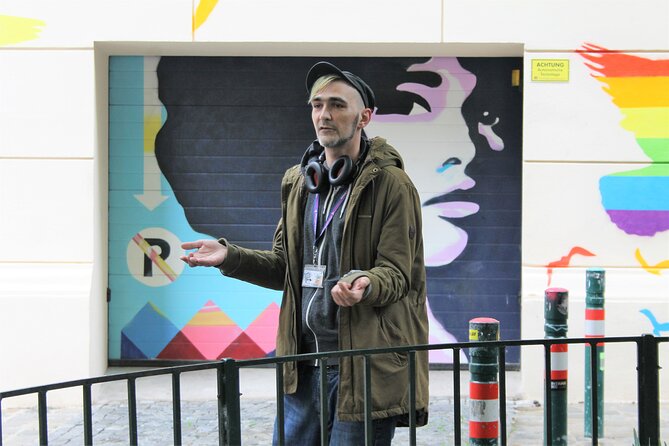
- Martin’s first-hand stories connect parks, stairs, and street corners to real life choices
- Two short stops keep it manageable, around 20 minutes each, for a total of about 2 hours
- Small group size (max 20) makes it easier to ask questions and stay engaged
- Street history meets local details, including the evacuation story tied to Anarchia
- Public-space route uses simple landmarks like Karlsplatz and the Secession area
- Dogs and service animals are allowed, and the tour is near public transportation
A Two Hour Walk Through Vienna You Usually Skip
Vienna has a postcard face. This tour trades that for a more honest one, where parks and stairways are more than background scenery. It is a focused route that shows you how people carve out space in the city, and what that means day to day.
What makes it work is the human scale. Instead of a list of monuments, you get a guided story with place-based explanations. Martin lived through the world he describes, so you hear the logic behind behaviors that might otherwise look confusing.
You will also notice how the route stays practical. It moves through public passages and reaches two main stops, then finishes near a major landmark (Haus des Meeres). This makes the tour easy to fold into a day without feeling like you need a full morning or evening commitment.
Other things people book around Vienna:
- Vienna: Vivaldi’s Four Seasons Concert in Karlskirche
★ 4.7 · 14,951 reviews - Vienna: Schönbrunn Palace & Gardens Skip-the-Line Tour
★ 4.7 · 7,739 reviews - Vienna: Light of Creation Votive Church Immersive Light Show
★ 4.8 · 6,779 reviews
Getting Started at Karlsplatz and the Subway Passage Beat
The meeting point is Police Inspectorate Vienna, Kärntnertorpassage (Karlsplatz), 1010 Wien. It is a solid starting location because it is tied to a busy transit area, so you are not hunting for a hidden street with no signage.
Right after you meet up, you go through the subway passage at Karlsplatz. Then you leave it at the exit next to the Secession, and you pass the Secession on the way to the next stop. That routing matters because it sets the tone early. You are already moving through the kinds of spaces most visitors just rush past.
One small advantage of the format: the early walking is straightforward. You are not doing a long trek across multiple neighborhoods, and you are not stuck for hours before the first major story. In about the time it takes to feel fully awake and oriented, you start hearing why these locations matter.
Stop 1 Alfred-Grünwald-Park, When a Park Becomes a Bedroom
Your first main stop is Alfred-Grünwald-Park. You are there for around 20 minutes, and it is described as having comfortable seating for all participants, which is a big deal on a story-heavy tour. When the topic is tough, the body needs a bit of support.
Martin explains why this park became his sleeping place. He also shares why it is advisable not to just sleep on the meadow, which adds an important layer. This is not about romanticizing hardship or turning survival into a concept, it is about the reality of safety, visibility, and the everyday risks people face.
If you are the kind of visitor who thinks you already understand a place because you can see it, this stop will likely challenge you. A public park can look like a single thing from the outside, but Martin shows how it becomes different depending on who is using it and when.
A practical note for your comfort: because seating is available, you can settle in without constantly balancing while listening. This makes the stop work well even if you are tired from earlier sightseeing.
Stop 2 Ilse-Pisk-Stiege and the Punk Story Behind Anarchia
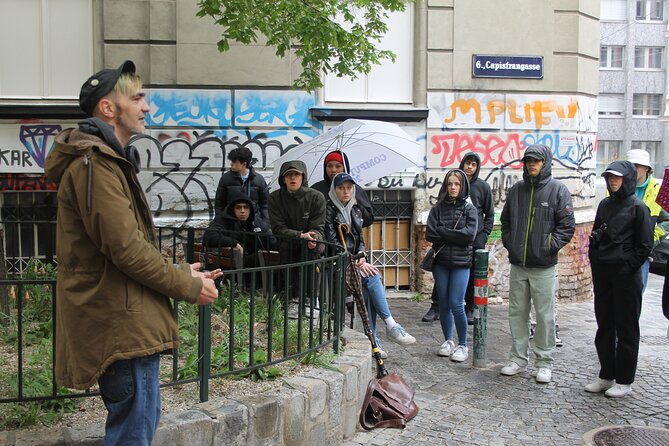
The second main stop is Ilse-Pisk-Stiege, with a penultimate stop around the stairs of the Capistr Ascent. You get another 20 minutes here, and it sounds like the route is built so you can pause and catch your breath on the stairs before the story hits its most political edge.
This is where Martin shifts into insights about squats and punks. You do not just hear general ideas. You hear a specific local history connected to a pizzeria called Anarchia, including a major evacuation.
The story is striking: a house occupied by 19 people was evacuated by 1700 police officers. That scale turns a piece of city lore into something you can actually feel, because it reveals how strongly authorities respond when informal housing, alternative culture, and public space collide.
You also get a sense of what “off the tourist track” really means. The tour is not only showing you side streets. It is showing you conflict, institutions, and the hard edges of city life that usually stay hidden behind polished facades.
One more benefit here: the pacing. You have shorter segments instead of one nonstop lecture. A rest point on the stairs helps keep the tour from feeling like it drags, and it gives you a moment to process what you just heard.
A completely different kind of day, same corner of Austria:
- Vienna Spanish Riding School Guided Tour
★ 4.7 · 6,765 reviews - Vienna: Classical Concert in the World-Famous Musikverein
★ 4.6 · 6,673 reviews - Vienna: Skip-the-Line Sisi Museum, Hofburg and Gardens Tour
★ 4.8 · 5,918 reviews - Vienna: Hallstatt & Alpine Peaks Day Trip with Skywalk Lift
★ 4.7 · 5,458 reviews
The Real Value: Learning Without Being Lectured
A lot of tours about tough topics turn into moral theater. This one tends to avoid that feel, because the structure is built around personal testimony and practical explanation.
Martin’s perspective is the center of it all. He is telling you what he saw and what he learned from being inside that world, including addiction and squatting as lived realities. The point is not to shock you for entertainment, it is to change how you interpret the city in front of you.
From what comes through in the tour experience, the approach also nudges you toward tolerance. You are not pushed to agree with everything, but you are encouraged to slow down your judgments. That matters in a city like Vienna where you can walk past homelessness without ever talking to anyone who understands the day-to-day mechanics.
And yes, it can also feel human in an unexpected way. Several accounts highlight that the guide can mix serious material with humor. That does not erase the difficulty, it just makes you more likely to stay engaged long enough to actually learn something.
Price and What You Get for 46 Dollars
The price is $46 for about 2 hours, with group discounts and a mobile ticket. On paper, it is not the cheapest thing in Vienna, but the format helps justify it.
Here is why it is good value for the money:
- You get a small-group setting with a maximum of 20 travelers, which is important when the story invites questions
- You get two substantial story stops plus route context through Karlsplatz and the Secession area
- The stops list admission ticket free, so you are not paying extra just to sit in a park or on stairs while someone explains a place’s meaning
- The guide’s lived experience is not something you can replicate with self-guided walking tours
If you like the kind of travel where you come away with sharper questions about society, this price starts to make sense. It is less about seeing more landmarks and more about seeing deeper into the same city you already think you know.
Small Details That Matter on a Human-Scale Tour
This experience is capped at maximum 20 travelers, and that matters more than people expect. With fewer people, you hear better, the story stays personal, and you are more likely to get answers if you have questions.
The tour also lists confirmation at time of booking, and it uses a mobile ticket. That makes it easier on the day you go. You do not need to hunt for paper tickets while you are already near transit and switching between passageways and outdoor stops.
It is also friendly for pet owners: dogs allowed and service animals allowed. Not every city walk clearly states this, so it is nice when your companion can come along.
Finally, the route is near public transportation. That helps you plan realistically, especially in Vienna where half the fun is walking between transit-connected neighborhoods.
Who Should Book This and Who Should Skip It
This tour fits best if you want:
- A Vienna experience that focuses on real social life, not just major sights
- A guided story built around homelessness, addiction, and squatting from a lived perspective
- A shorter, manageable walking format, about 2 hours total
- A tour where humor and seriousness can both show up, because people are complex
You might want to skip it if you know you are not comfortable with heavy subjects. Also, if you are expecting a classic highlights route with lots of monument time, this will feel different.
For families, there are mentions of school groups and teenage audiences doing the tour, which suggests it can work for younger participants. Still, it is smart to think about your own comfort level and how you want to discuss tough topics while traveling.
If you are a student, an educator, or simply someone who cares about how cities handle inequality, you will probably get a lot out of it. The route connects policy, police presence, informal housing, and culture to specific places you can point to on a map afterward.
Arriving, Stopping, and Ending Near Haus des Meeres
The walk ends at Esterhazypark G, 1060 Wien, right next to Haus des Meeres. That is convenient because it gives you a clear finish point, and it is close to an easy-to-understand destination area.
Use this to your advantage. If you still have energy after the tour, you can keep walking or grab a snack nearby without needing extra planning. If you are tired, at least you are ending near a known point rather than in a maze of streets.
Also, since you are moving through Karlsplatz and public passages early on, wear shoes you can trust. You are not doing extreme hiking, but you will be on foot and on stairs.
Should You Book This Tour?
I think you should book this if you want Vienna that feels real, with a guide who speaks from lived experience and a route built around concrete places like Alfred-Grünwald-Park and Ilse-Pisk-Stiege. The $46 price is more reasonable than it looks because you get a small group, a structured 2-hour walk, and story stops where the guide can explain why people use these spaces.
I would skip it if you want a purely visual, light-hearted sightseeing day. This tour is about society’s hard edges, told plainly.
If you do book it, come with an open mind and basic respect. Ask questions if you have them, but also give the guide space to tell the story in his own way. That is when the tour becomes more than information, it becomes a new way to see the city you walk through every day.
FAQ
How long is the Vienna off the tourist track tour?
It runs for about 2 hours.
How much does the tour cost?
The price is $46.
Where do I meet and where does the tour end?
You meet at Police Inspectorate Vienna, Kärntnertorpassage (Karlsplatz), 1010 Wien. You end at Esterhazypark G, 1060 Wien, right next to Haus des Meeres.
How many people are in the group?
The tour has a maximum of 20 travelers.
Are there any extra admission tickets at the stops?
The listed stops show admission ticket free.
Can I bring a dog or a service animal?
Yes, service animals are allowed, and dogs are allowed.
Is free cancellation available?
Yes. You can cancel up to 24 hours in advance for a full refund.
Recently reviewed around Vienna
- Vienna Private Full Day Tour – Tickets to Schönbrunn & Lunch★ 5.0 · 3 reviews
- Vienna: Private Half-Day Sightseeing Tour★ 4.1 · 9 reviews
- Vienna: Old Town Walking Tour with a Local Guide★ 4.6 · 52 reviews
- Vienna Portrait Experience: Exclusive Vienna Photo Shoot★ 5.0 · 7 reviews
- Vienna: Private 3-Hour City Highlights Van Tour★ 4.3 · 6 reviews
- Vienna: Old Town Highlights Private or Group Walking Tour★ 4.6 · 66 reviews
- Vienna Nightlife: Food, Wine, Cocktails and Rooftop Bar Tour★ 4.9 · 17 reviews
- Vienna: Old Town Professional Photowalk★ 4.7 · 33 reviews
Tours, side by side.
Schönbrunn Palace & Gardens Skip-the-Line Tour
Read our review →

Skip-the-Line Sisi Museum, Hofburg and Gardens Tour
Read our review →
Skip-the-Line Schönbrunn Palace & Gardens Tour
Read our review →
Guided Walking Tour of City Center Highlights
Read our review →
Hop-On Hop-Off Sightseeing Bus Tour in 19 Languages
Read our review →